What is art?

Art is a language that artists use to express ideas and feelings that everyday words cannot express.
Throughout time, the arts have been essential to human existence. When people create in images, they discover ways to shape and share their thoughts and feelings with others. The arts enrich quality of life. All students deserve access to the arts through creation, performance and study. The fine arts are fundamental ways of knowing and thinking. In addition to their intrinsic value, the arts contribute to children's development.
Works of art are some of the highest achievements of civilization. In school, students learn the language of the arts and how to interpret visual images. Because the arts are both universal and culturally specific, they are a powerful means of increasing international and intercultural awareness. Through the arts, students gain a greater understanding of their own cultural heritage, as well as a sense of the larger world community.
Source: isbe.net

Monday, May 13, 2013

Pastel Cats Inspired by Paul Klee

First off, let me say that I was so happy to be able to meet some of my students' families during Specials Night. I think the children really enjoyed seeing their artwork on display, and it was a fun night for everyone.

Last week in art class, we were inspired by Swiss artist Paul Klee and his painting "Cat and Bird." (See below):

I introduced chalk pastels to the children, most of whom had never used them before, and we experimented blending colors with our fingers. It's a messy medium, but the colors are so rich and beautiful. Then, using a black oil pastel on brown construction paper, we drew our kooky cat faces. The chalk pastels were then used to add color and personality. I'm so delighted with how the cats turned out: they are all unique and very expressive!


Cade
(lesson credit: http://www.deepspacesparkle.com/)

Tuesday, May 7, 2013

Specials Night Watercolors and Color Theory

For the past two weeks, we have been working on our artwork for Specials Night. We reviewed the color wheel and talked about mixing the primary colors. Students were given watercolor paper that was taped off into rectangular sections. Using just the three primary colors in liquid watercolor form, students began their experiments in color mixing. We used the wet-on-wet technique so the colors really spread and exploded into beautiful abstract shapes. There were a lot of exclamations of surprise and delight as the children discovered all the various hues they could create with different color combinations. The last step was to sprinkle some table salt onto the wet paint to add some visual texture.
The following week, after the paint was completely dry and the tape had been removed leaving white spaces on the paper, the children used Sharpie markers to add a variety of patterns. During Spanish class, the children wrote out their color mixing formulas and glued this to their art. These beautiful explorations in color theory are on display for Specials Night in the hallway by the art room. Hope to see you all there!


Friday, April 12, 2013

Classic Self-Portraits

These are so adorable! This week, we did a one-day project introducing the children to a classic self-portrait. The project involved using a variety of media and techniques, including collage, drawing with markers, and painting with tempera cakes. We discussed the parts of a human face and the proportions of a face. Then the students got to work. They chose a piece of construction paper that they thought matched their skin tone, and some yarn that matched their hair color (although, as you will see below, some children chose colors they liked instead of realistic colors, and that was okay!). After drawing in facial details with marker, the clothing and backgrounds were painted in. I think they did a great job - so full of personality!


Sunday, April 7, 2013

African Stamp-making and Paper Weaving

This latest project was a very challenging one for the children but they rose to the challenge and did a fantastic job. The lesson was inspired by Adinkra cloth created by the Ashanti people of Ghana. We began by reading the book, "The Talking Cloth" by Rhonda Mitchell, which tells the story of a little girl who learns about Adinkra from her grandmother. We then looked at examples of Adinkra symbols, which have a variety of meanings, like pride, loyalty, family and love. I brought in two Adinkra stamps (carved from dried gourds) to show the children. Then we began our paper weaving, focusing on going over/under/over/under, and using color to create patterns.

After the weaving was complete, the children practiced drawing Adinkra symbols in their sketchbooks. They chose a couple of symbols they liked, or created their own new ones, and using a pencil, "carved" the symbols onto pieces of styrofoam. The final step was to use their styrofoam stamps and some tempera paint to stamp onto their paper weavings. Beautiful examples below:


Martin


Monday, March 18, 2013

Printmaking inspired by Andy Warhol

This latest project introduced the children to the work of Andy Warhol. We began by looking at examples of some of his work and reading a book about him called "Uncle Andy." The children noticed the bright colors he liked to use in his work, and we discussed the printmaking process and why his work was called "Pop Art." The first step for the children was to make hand prints using fun, neon-colored tempera paint. Then they chose some rectangles of brightly colored paper and glued them to a black background. The most challenging part of the project for the students was to cut out their hand prints, working carefully around the fingers, and then glue them to the background paper to complete their collage. The six collages below are by: Annie, Cade, Charlie, Ela N., Ella U. and Graham.


The collages below are by: Jaylynn, Kaylen, Myima, Peter, Violet, Will and Martin. (Please note that if you do not see your child's collage listed, it means they were absent for this project).


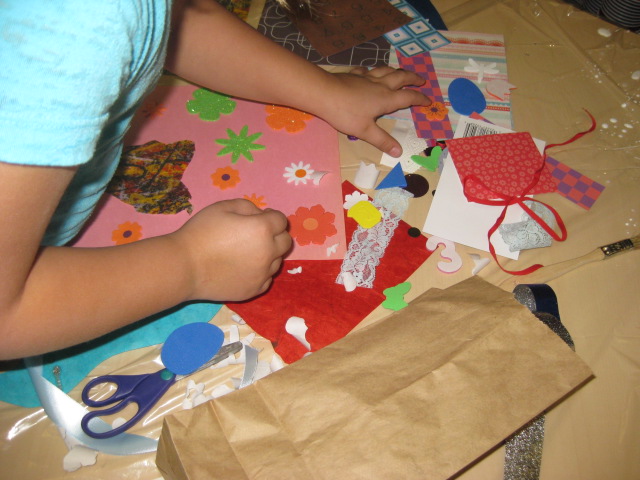
 If students finished their Andy Warhol-inspired art before the end of class period, they could choose a bag of collage materials and create a "free choice" collage. The children really enjoyed discovering the various collage items and the photos below are of some of the works-in-progress. This next week, we will begin another printmaking project, combined with paper weaving, inspired by Adinkra symbols used by the peoples of Ghana.


Monday, March 11, 2013

A note about sketchbooks....

This past January, we started a new thing in art class: using sketchbooks! Each student was given a sketchbook that I had put together for them, and this has turned into a fun and engaging activity that I either use as a "warm-up" at the beginning of class, or as an option for students who finish the art project early, and need something to do while the other students are still working. Inside the sketchbooks are several art activities which students can work through at their own pace, and in any order they choose. When they complete a page, they are given a sticker. Activities include copying shapes and lines, and idea prompts for free-choice drawing. These activities encourage students to look attentively and really see the elements of an image. They also help warm up the small muscles in the hands, and in the arms and shoulders. Additionally, sketchbooks are great for getting the brain ready to think about and make art. At the end of the year, the sketchbooks will go home with the students' portfolios and will be a nice record of their artistic ideas and growth.


Ceramic pendants finished into necklaces this past week!

This past week, the children were very excited to finally be able to finish off their ceramic pendants by making them into necklaces using colorful shoelaces and an assortment of beads.
Before we began, we reviewed the process and vocabulary involved in making the ceramics, and then we talked about some of the choices they could make as artists. For instance, if they wanted to incorporate pattern and/or symmetry in their necklace design. We also brainstormed about color choice and reviewed the color wheel. Then the children got started. The process of sorting through and choosing beads, and the actual stringing of beads (fantastic fine motor practice) was very engaging and kept the children happily busy for the entire class time.


This photo is of some of the finished necklaces. The girls noticed that when they put their hearts together, it formed a four-leaf clover!
At the end of class, we took a group photo, and then the students were able to take home their necklaces, along with the ceramic leaf bowls that were made in the fall with the substitute art teacher.

This coming week, we will finish our Andy Warhol-inspired print/collage and review collage techniques.